——HuSir风格史诗 · 更宏大、更象征、更自由
前言
2084年,人类已经学会用更冷静的目光回望过去。
许多曾被视为恒久的秩序,
在时间的远处,
看起来不过是一段阶段性的结构偏航。
一位年迈的史官在整理旧世纪的档案时,
讲述了这样一个寓言。
那是一片曾长期陷入阴影的土地。
并非因为太阳消失,
而是因为阳光被层层机制所折射与遮蔽。
在那片土地上,
“光”并非自然之物,
而是一种被分配、被管制、被集中掌握的资源。
人们在那里生活了很久,
久到忘记了天空本来的颜色,
久到把黑暗视作常态,
把沉默训练成美德。
后来的世界并不急于指责那段历史。
因为它早已明白——
真正值得记录的,
不是一个帝国如何统治,
而是一个民族
如何在长夜中
一步步失去光,
又如何重新记起光。
这部寓言,
便是关于那个被称为
“长夜王朝” 的时代。
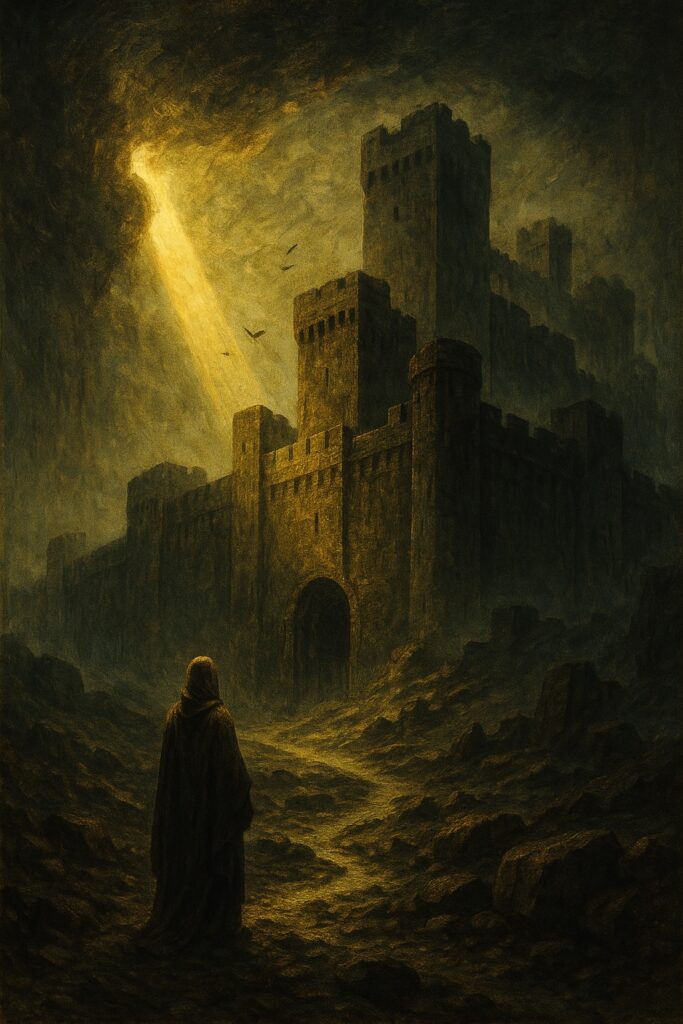
序章:世界诞生时的裂缝
起初,大地如同一张被历史烧灼过的羊皮纸,
山河是未愈合的伤口,
人类在伤口上建国,
又在国上叠加新的伤口。
那时,诸神沉默,
世界只剩下风与废墟。
就在风吹过的那一刻,
大地深处传来一种古老的震颤:
一种力量正在形成,
一种将决定万民命运的力量——
大地需要一个主人。
于是,一个王朝从裂缝中生长出来,
像远古树根般沿着时间缠绕上去,
在黑暗中完成自己的诞生。
人们称它为——
长夜王朝。
第一章:铁之心脏的时代(秦之影)
长夜王朝的第一颗心脏由铁铸成,
沉重、冰冷、不容迟疑。
它在夜里跳动时,
所有人的脚步随之统一,
所有的思想被压入同一模具,
所有的故事只能保留一个版本。
城墙高到遮蔽天空,
史官的笔被赋予裁决的锋刃,
真理被重铸为秩序的工具。
百姓在铁心的节奏中学会沉默:
沉默意味着生存,
沉默意味着理性,
沉默成为唯一可被传承的财富。
然而无人察觉,
铁心的跳动越来越快,
越来越用力,
仿佛要把整个大地踏成同一平面。
直到有一天,
铁心的节奏中断了一拍,
城墙上落下一块砖,
无人敢触碰。
这是长夜王朝的第一次颤动——
当时没有名字,
后来的人称之为:
承载极限。
第二章:无穷工程之王(隋之影)
铁心出现裂纹之后,
王朝长出第二颗心脏:
不是铁,
而是火。
这颗火心
持续追求超出常识尺度的工程:
通天之塔、贯古今之道、横海之桥……
它相信,
只要不断修建、不断挖掘、不断扩展,
万民终将获得幸福,
大地终将顺服秩序。
于是动员令如潮水扩散:
田地被征用,
劳力被调配,
财富被集中。
人民的脊背弯成山脉,
山脉上流淌着汗水与时间——
一切都被指向“未来”。
然而火心从未提出疑问:
这片土地,
还能承载多少消耗?
燃烧越旺,
人民越被视为燃料;
温度越高,
大地越失去光泽。
某一年秋天,
粮仓在风中发出空洞的回声。
火心依旧跳动,
而大地已显疲态。
这是长夜王朝的第二次崩颤,
后来被命名为:
承载的终点。
第三章:以墙为国的时代(晚清之影)
火心余温未散,
王朝又生成第三颗心脏,
被称为——
墙心。
墙心不再向外开拓,
而是向内聚焦;
不再建设,
而是加固;
不再治理,
而是监视。
城墙变得更厚,
告示如蛛网覆盖空气。
百姓的日常被重塑为一种姿态:
睁眼,看墙;
闭眼,避墙;
言语,绕墙;
沉默,藏身。
整个王朝如同一艘巨船,
却把所有木料
都用于堵塞渗漏,
失去了继续航行的能力。
墙心最擅长的,
是延长系统的存续,
而非开辟未来。
渐渐地,人们发现:
他们不再需要外部敌人,
因为墙本身
已足以将一个民族
围成封闭结构。
直到某一夜,
远方传来第一声裂响,
如冰层松动,
如春意试探长夜。
声音极其微弱,
却被最敏感的人捕捉。
史册记下这一刻:
墙的疲惫。
第四章:行走者之歌(未来之影)
长夜王朝的力量源自三颗心脏,
而它最难以应对的,
并非刀兵、叛军或灾变,
而是一种逐渐成形的判断:
“我,不再愿意继续生活在长夜之中。”
这种判断
最早出现在那些
行走最久、承压最深、
长期保持沉默的人心里。
他们后来被称为——
行走者。
行走者没有旗帜,
没有宣言。
他们只坚持三件事:
不助长黑暗,
不重复谎言,
不让灵魂枯竭。
有人在河岸醒悟,
有人在山林中卸下铁锁,
有人在最灰暗的清晨
第一次辨认出
从城外折射而来的光。
行走者逐渐增多,
他们的脚步
在大地上形成隐秘路径。
王朝试图以墙阻断他们,
但墙心逐渐意识到:
它最难以应对的,
不是叛逆,
而是一个不再自动顺从的人。
因为一人醒来,
便会唤醒他人;
同行之路出现,
路径便不断延展。
在长夜的边缘,
大地第一次听见
王朝无力的回声:
原来瓦解一个帝国的,并非力量不足,而是人民开始追寻光。
第五章:光的来访(外部世界之影)
长夜王朝缓慢旋转了许多个世纪,
城墙如年轮层层叠加,
将文明困于阴影之内。
某一时期,
一道外来的光
自海的方向照入。
那并非王朝召唤之光,
亦非预言中的光,
而是来自墙外世界——
一个奔跑、开放、自由呼吸的世界。
光掀开城墙一角,
照亮此前未被见过的景象:
灵动的机器,
广阔的市场,
迅捷的交流,
辽阔的思想。
这是王朝第一次
与外部世界发生实质接触。
史官后来将这段时期称为
“小阳春时代”——
一个光明几乎照入整个帝国的年代。
百姓在光下发现:
其他文明并未沉睡,
也未敌对。
他们交易、迁徙、思考,
他们的歌声不是嘲讽,
而是召唤。
人心第一次出现波动——
一种温和而危险的判断:
“夜之外,确实存在世界。”
然而王朝随之感到不安。
光越清晰,
墙心越不稳。
它担忧节奏被扰乱,
欲望被质疑,
结构被看穿。
于是,王朝作出关键抉择:
拒绝光。
它未曾意识到——
拒绝光明
并非封闭的起点,
而是系统性衰减的倒计时。
外部史官后来如此记录:
“他们曾接近成为新的文明,
却选择了以恐惧替代开放。”
但光已留下种子。
人民已知:
夜并非全部,
墙外仍有天空。
终章:长夜王朝的命运
长夜王朝的终结
并非源于推翻,
亦非源于入侵,
而是源于对光的持续拒绝。
光曾短暂照入,
加速脚步,
唤醒心智,
王朝一度触及自我更新的可能。
但光越深入,
墙心越收紧。
城门再次关闭,
受光者被标记为风险。
王朝误以为
这样可以恢复安静。
它未曾预见——
光被驱逐得越远,
人民对光的记忆越清晰。
而一个记住光的民族,
不可能再完全回到黑暗。
铁心的节奏不再齐步,
火心的号令难以点燃,
墙心的威严失去依附。
王朝失去了人心。
而失去人心,
比失去疆土更致命。
史册将这一阶段记为:
“人心向背之战——
未动刀兵,却失去未来。”
当铁心停跳、
火心冷却、
墙心出现裂隙,
王朝终于明白:
帝国并非死于敌人,而是死于拒绝光明。
后来的史官写道:
“世界曾伸出手,
他们却选择握紧拳头。
世界不能强迫一个王朝成长,
也无法阻止它走向自身的结局。”
在微光之中,
人民记住:
“我们没有推翻长夜,长夜是被自身的恐惧一点一点耗尽的。”
大地进入微光期。
孩子重新出生,
河流重新奔跑,
思想再次生长。
行走者回望旧城废墟,
只是低声说道:
“真正的毁灭不是战争,而是当王朝拒绝光,而人民拒绝再为黑暗点灯。”
史官在《长夜纪》的最后一页写下:
“一个王朝的终结,不在黑暗本身,而在它拒绝光。”
The Chronicle of the Long Night
— An Ancient Allegory from the Year 2084
A HuSir-style epic · more expansive, more symbolic, more free
Preface
By the year 2084, humanity has learned to look back upon the past with a calmer gaze.
Many orders once regarded as permanent,
when viewed from the distance of time,
appear merely as episodes of structural deviation.
While organizing archives from the previous century,
an elderly historian recounted the following allegory.
It spoke of a land that had long been shrouded in shadow.
Not because the sun had vanished,
but because sunlight was refracted and obscured by layered mechanisms.
In that land,
light was not a natural condition,
but a resource that was allocated, regulated, and centrally controlled.
People lived there for so long
that they forgot the original color of the sky,
so long that darkness was treated as normality,
and silence was trained into a virtue.
The later world does not rush to condemn that history.
For it has already learned—
what truly deserves to be recorded
is not how an empire ruled,
but how a people,
within a long night,
gradually lost the light,
and how they eventually remembered it again.
This allegory
is about the era known as
the Long Night Dynasty.
Prologue: The Fissure at the Birth of the World
In the beginning, the land resembled a sheet of parchment scorched by history.
Mountains and rivers were unhealed wounds.
Humanity built states upon wounds,
and layered new wounds upon old states.
The gods were silent.
The world was left with only wind and ruins.
Then, as the wind passed,
a deep tremor arose from within the earth—
a force taking shape,
a force that would determine the fate of multitudes.
The land required a master.
Thus, from the fissure, a dynasty grew—
like ancient roots coiling through time,
completing its birth within darkness.
People called it—
the Long Night Dynasty.
Chapter I: The Age of the Iron Heart (The Shadow of Qin)
The first heart of the Long Night Dynasty was forged of iron:
heavy, cold, permitting no hesitation.
When it beat in the night,
all footsteps moved in unison,
all thoughts were pressed into the same mold,
all stories were reduced to a single version.
Walls rose high enough to block the sky.
The pens of historians were given the edge of judgment.
Truth was reforged into an instrument of order.
Under the rhythm of the iron heart,
the people learned silence:
silence meant survival,
silence meant rationality,
silence became the only inheritance passed to the next generation.
Unnoticed, the iron heart beat faster,
harder,
as though intent on flattening the entire land.
One day,
its rhythm skipped a single beat.
A brick fell from the wall.
No one dared touch it.
This was the first tremor of the Long Night Dynasty.
It had no name at the time.
Later generations called it:
The Limit of Bearing.
Chapter II: The King of Endless Works (The Shadow of Sui)
After fractures appeared in the iron heart,
the dynasty grew a second heart—
not of iron,
but of fire.
This fire-heart pursued projects beyond the scale of common sense:
towers reaching the heavens,
roads spanning ancient and modern eras,
bridges crossing seas.
It believed that through ceaseless construction, excavation, and expansion,
the people would be made happy,
and the land would submit.
Mobilization orders spread like tides:
fields were requisitioned,
labor was reassigned,
wealth was centralized.
The backs of the people bent into mountain ranges,
upon which sweat and time flowed—
all directed toward the future.
The fire-heart never asked:
how much more could this land endure?
The brighter the blaze,
the more people were regarded as fuel.
The higher the heat,
the duller the land became.
One autumn,
granaries echoed hollowly in the wind.
The fire-heart still pulsed,
but the land had grown weary.
This was the dynasty’s second rupture,
later named:
The End of Bearing.
Chapter III: The Age of the Wall-State (The Shadow of Late Qing)
Before the embers cooled,
the dynasty formed a third heart—
called the Wall Heart.
The wall-heart no longer expanded outward,
but focused inward.
It no longer built,
but reinforced.
It no longer governed,
but surveilled.
Walls thickened.
Notices spread like webs, covering the air.
Daily life was reshaped into posture:
eyes open—watch the wall;
eyes closed—avoid the wall;
speech—circle the wall;
silence—hide within it.
The dynasty became a massive vessel,
using all its timber to plug leaks,
losing the capacity to sail.
The wall-heart excelled at extending survival,
not at opening futures.
Gradually, people realized
they no longer needed external enemies,
for the wall itself
was sufficient to enclose an entire people
within a closed structure.
One night,
a distant crack sounded—
like ice loosening,
like spring testing the long night.
The sound was faint,
but the most sensitive heard it.
History recorded the moment as:
The Fatigue of the Wall.
Chapter IV: The Song of the Walkers (The Shadow of the Future)
The power of the Long Night Dynasty came from three hearts.
Yet what it found hardest to confront
was not weapons, rebellion, or catastrophe,
but a judgment slowly taking shape:
“I am no longer willing to live in the long night.”
This judgment first appeared
in those who had walked the longest,
borne the greatest pressure,
and maintained silence the deepest.
They came to be called—
the Walkers.
The Walkers bore no flags,
issued no proclamations.
They upheld only three things:
not amplifying darkness,
not repeating falsehoods,
not allowing the soul to wither.
Some awakened by riverbanks,
some loosened iron locks in forests,
some, in the bleakest mornings,
first discerned light refracted from beyond the walls.
Their numbers grew.
Their footsteps traced hidden paths across the land.
The dynasty attempted to block them with walls,
but the wall-heart gradually understood:
what it struggled against
was not rebellion,
but a person who no longer obeyed automatically.
For when one awakens,
others follow.
When a path forms,
it extends.
At the edge of the long night,
the land heard the dynasty’s weakening echo:
An empire does not unravel from lack of force,
but when its people begin to seek light.
Chapter V: The Visit of Light (The Shadow of the Outer World)
The Long Night Dynasty rotated slowly for centuries,
walls layered like rings of age,
confining civilization within shadow.
Then, in a certain era,
an external light entered
from the direction of the sea.
It was not summoned by the dynasty,
nor foretold by prophecy.
It came from beyond the walls—
a world that ran, opened, and breathed freely.
The light lifted a corner of the wall,
revealing scenes unseen before:
agile machines,
vast markets,
rapid exchanges,
expansive ideas.
For the first time,
the dynasty made substantive contact with the outside world.
Later historians called this period
“the Lesser Spring”—
an age when light nearly reached the entire empire.
Under that light, the people discovered:
other civilizations were neither asleep nor hostile.
They traded, migrated, and thought.
Their songs were not mockery,
but invitation.
Human hearts stirred—
a gentle yet dangerous judgment:
“Beyond the night, a world truly exists.”
The dynasty grew uneasy.
The clearer the light,
the more unstable the wall-heart became.
It feared disrupted rhythms,
questioned desires,
and transparent structures.
Thus, the dynasty made its critical choice:
to refuse the light.
It failed to realize—
refusing light
is not the beginning of closure,
but the countdown to systemic decay.
Later, external historians wrote:
“They came close to becoming a new civilization,
yet chose fear over openness.”
But seeds of light had already been planted.
The people now knew—
night was not everything,
and sky still existed beyond the walls.
Epilogue: The Fate of the Long Night Dynasty
The end of the Long Night Dynasty
did not come from overthrow,
nor invasion,
but from its persistent refusal of light.
Light once entered briefly,
accelerating steps,
awakening minds.
The dynasty nearly reached self-renewal.
Yet the deeper the light went,
the tighter the wall-heart drew.
Gates closed again.
Those touched by light were marked as risks.
The dynasty believed silence would return.
It did not foresee—
the farther light was expelled,
the clearer its memory grew.
A people who remember light
cannot fully return to darkness.
Iron rhythms lost unity.
Fire commands lost ignition.
Wall authority lost adherence.
The dynasty lost the hearts of the people.
And losing hearts
is deadlier than losing territory.
History named this phase:
“The Battle of Allegiance—
no blades drawn,
yet the future lost.”
When the iron heart ceased,
the fire heart cooled,
and cracks spread through the wall-heart,
the dynasty finally understood:
Empires do not die by enemies,
but by refusing light.
Later historians wrote:
“The world once extended a hand.
They chose instead to clench a fist.
The world cannot force a dynasty to grow,
nor prevent it from reaching its own end.”
In the dim light that followed,
the people remembered:
“We did not overthrow the long night.
It was consumed,
grain by grain,
by its own fear.”
The land entered a period of faint light.
Children were born again.
Rivers ran again.
Thought grew again.
The Walkers looked back upon the ruins
and said softly:
“True destruction is not war,
but when a dynasty refuses light,
and the people refuse to light the darkness.”
On the final page of The Chronicle of the Long Night,
the historian wrote:
“The end of a dynasty lies not in darkness itself,
but in its refusal of light.”
发表回复