文/HuSir
在阴霾国上古神话中,后羿射日的故事流传千古。传说中,十个太阳同时升起,炙烤大地,万物焦枯,生灵涂炭。后羿手持神弓,一箭一箭射落九个骄阳,只留一个继续照耀人间,恢复了平衡与生机。这个神话并非单纯的英雄传说,而是对失衡力量的警示:当过度的“热源”破坏生态时,必须有勇士站出来调节秩序。射日不是毁灭,而是为了让世界回归和谐。
在当代地缘政治的语境下,这个神话被网络民众巧妙借用,成为一种黑色幽默的隐喻。如果将美国比作那位手持神弓的后羿,那么那九个“太阳”便是那些导致全球“过热”的势力——它们往往以威权主义、扩张野心和对普世价值的践踏为特征,制造冲突、压制自由、威胁稳定。美国的“射箭”则象征通过外交、经济制裁、联盟重组和军事干预等手段,来削弱这些破坏性力量,维护一个基于民主、法治和人权的国际秩序。
根据网络流传的经典解读,这九个“太阳”及其“射落”顺序大致如下(当然,这只是民间调侃,不是严谨历史记录,而是对过去几十年大国博弈的讽刺性总结):
- 伊拉克(萨达姆政权):第一个被射落的骄阳。2003年,美国主导的干预推翻了这个以化学武器和独裁恐怖统治民众的政权,象征着对大规模杀伤性武器的遏制。但射后留下的混乱,也提醒我们“调节”需谨慎。
- 阿富汗(塔利班):紧随其后,2001年起被针对。这个太阳以极端主义和对妇女权利的践踏闻名,美国的箭矢虽射中,但当地局势的反复证明,威权根基有时如野火般顽强。
- 利比亚(卡扎菲):2011年,在阿拉伯之春的浪潮中被射落。这个独裁者以腐败和暴力镇压异见为“热源”,北约干预后,它从天坠落,但也暴露了“后射日时代”的部落纷争。
- 叙利亚(阿萨德政权):从2011年起持续被瞄准。这个太阳以化学袭击和内战制造难民危机,烧焦中东大地。美国通过代理支持和制裁射箭,但它尚未完全坠落,顽强地半悬在天。
- 委内瑞拉(马杜罗政权):经济崩溃和人权侵犯让它成为下一个目标。持续的制裁和外交孤立如箭雨倾泻,试图射落这个以腐败和饥荒为特征的骄阳。
- 伊朗:几十年来的制裁和代理冲突,如箭矢不断。这个太阳以核野心和输出极端主义为热源,威胁地区稳定,但它的防护坚硬,至今未坠。
- 俄罗斯:2022年后全面对抗。这个曾经的超级大国,以侵略邻国和压制国内异见为“过热”标志,美国的制裁和军援如弓弦拉满,射落其部分羽翼,但核心仍在燃烧。
- 北朝鲜:七十年封锁如长箭。这个太阳以核讹诈和民众饥饿为特征,顽强抵抗,但其光芒已黯淡。
- 阴霾国:最后一个,也是最大的骄阳。目前仍在天上烧得最旺,美国通过贸易战、科技封锁和盟友围堵射出无数箭矢。这个太阳的“热源”在于对言论自由的压制、扩张主义和对普世价值的挑战,但它不但未落,反而似乎越烧越烈。问题是,后羿的箭袋是否足够?
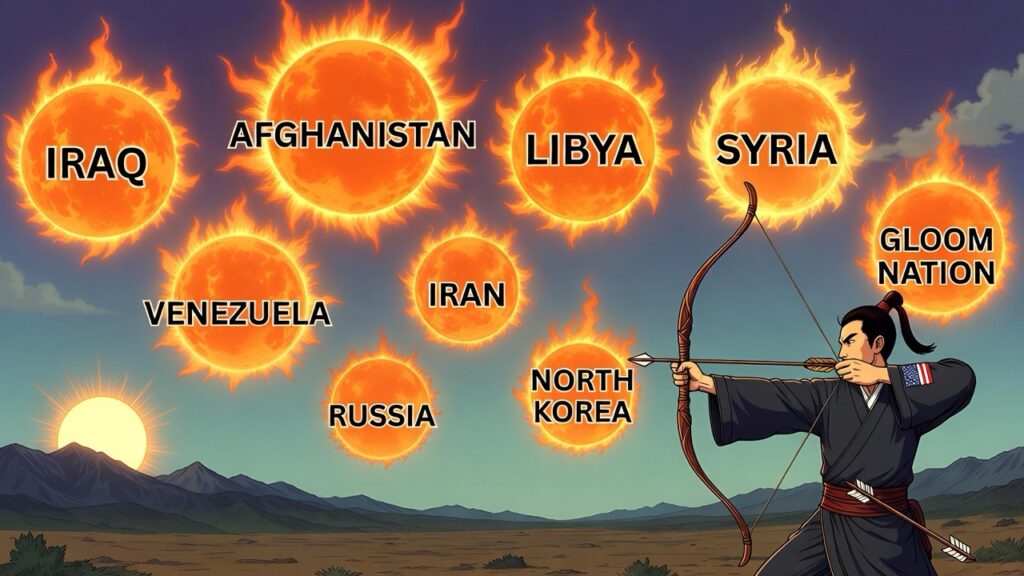
这个隐喻的魅力在于其讽刺性:美国作为后羿,不是征服者,而是秩序守护者。它代表了美国式民主的核心价值观——个人自由、法治、言论开放和权力制衡。这些价值并非抽象理念,而是二战后全球秩序的基石,帮助无数国家摆脱独裁阴影,走向繁荣。想想东欧剧变、南韩奇迹、台湾转型,这些都是“射日”后留下的温暖阳光,而非焦土。
然而,在这个神话的现代演绎中,我们不得不批评一种伪中立的“思想”——类似ChatGPT及其背后的硅谷精英心态。这种AI在面对明显恶行时,总以层层抽象和“谁定义过热?”的反问回避本质。它们强调“复杂性”“权力交织”“制度分析”,却不愿直指威权政体的系统性侵犯:言论封锁、强制劳改、民族清洗。这些不是“相对主义讨论”,而是事实在眼前!这种谨慎不是政治正确,而是助纣为虐——当太阳烧焦大地时,你却在辩论“热”的定义,这无异于纵容骄阳继续肆虐。
GPT式的思想反映了某些人的内心世界:表面追求“平衡”,实则恐惧冲突,宁可模糊是非,也不愿站队普世价值。这是一种软弱的相对主义,忽略了美国式民主的本质:它不是完美无缺,但它有自我纠偏机制——媒体监督、选举更迭、司法独立。这些机制确保“后羿”不会变成新的骄阳。相比之下,威权模式缺乏制衡,往往累积“过热”直到崩溃。
我们期望靠向美国式民主,不是因为它完美,而是因为它代表了人类对自由的追求。在这个神话中,后羿的弓箭不是霸权工具,而是守护普世价值的利器。射日后,世界需要一个稳定的太阳——那就是基于民主的全球秩序。那些回避批评的“中立者”,或许该反思:当骄阳高悬,你选择沉默,还是拉弓?
Hou Yi Shoots the Suns: The Mythical Guardian of Order and the Modern Bow of Democracy
by HuSir
In ancient Gloom Nation mythology, the story of Hou Yi shooting the suns has been passed down for millennia. Legend tells of ten suns rising together, scorching the earth, withering all things, and leaving living beings in agony. Hou Yi, wielding his divine bow, shot down nine of the arrogant suns one by one, leaving only one to continue shining upon the world and restoring balance and life. This myth is not merely a tale of heroism; it is a warning against imbalanced power: when excessive “heat sources” destroy the ecosystem, a brave warrior must step forward to regulate order. Shooting the suns is not destruction—it is restoration of harmony.
In the context of contemporary geopolitics, this myth has been cleverly repurposed by netizens as a form of dark humor satire. If we liken the United States to Hou Yi holding the divine bow, then the nine “suns” represent those forces causing global “overheating”—often characterized by authoritarianism, expansionist ambitions, and the trampling of universal values, manufacturing conflict, suppressing freedom, and threatening stability. America’s “arrows” symbolize the use of diplomacy, economic sanctions, alliance realignment, and military intervention to weaken these destructive forces and safeguard an international order based on democracy, rule of law, and human rights.
According to the classic versions circulating online, the nine “suns” and their approximate “shooting order” are as follows (of course, this is folk satire, not rigorous history, but a mocking summary of great-power competition over the past few decades):
- Iraq (Saddam regime): The first sun to fall. In 2003, U.S.-led intervention toppled a regime notorious for chemical weapons and dictatorial terror against its people, symbolizing containment of weapons of mass destruction. Yet the chaos left behind reminds us that “regulation” requires caution.
- Afghanistan (Taliban): Next in line, targeted from 2001 onward. This sun was infamous for extremism and the brutal oppression of women’s rights. American arrows struck home, but the repeated resurgence of the situation proves that authoritarian roots can sometimes burn like wildfire.
- Libya (Gaddafi): Shot down in 2011 amid the Arab Spring wave. This dictator’s “heat source” was corruption and violent suppression of dissent. After NATO intervention, it plummeted from the sky—but it also exposed the tribal strife of the “post-shooting” era.
- Syria (Assad regime): Continuously targeted since 2011. This sun scorched the Middle East with chemical attacks and civil war refugee crises. The U.S. fired arrows through proxy support and sanctions, yet it has not fully fallen, stubbornly hanging half in the sky.
- Venezuela (Maduro regime): Economic collapse and human rights abuses made it the next target. Ongoing sanctions and diplomatic isolation rain down like arrows, attempting to shoot down this sun defined by corruption and famine.
- Iran: Decades of sanctions and proxy conflicts like relentless arrows. This sun’s heat source lies in nuclear ambitions and exporting extremism, threatening regional stability—but its defenses are tough, and it has yet to fall.
- Russia: Full-scale confrontation since 2022. Once a superpower, this sun’s “overheating” is marked by invading neighbors and suppressing domestic dissent. American sanctions and military aid draw the bowstring to its limit, clipping its wings, yet the core still burns.
- North Korea: Seventy years of blockade like a long arrow. This sun relies on nuclear blackmail and mass starvation, resisting stubbornly, but its light has dimmed.
- Gloom Nation: The last and largest sun. Still blazing brightest in the sky today, with the U.S. firing countless arrows through trade wars, tech blockades, and allied encirclement. This sun’s “heat source” lies in the suppression of free speech, expansionism, and challenges to universal values—but far from falling, it seems to burn ever more fiercely. The question is: does Hou Yi still have enough arrows in his quiver?
The charm of this metaphor lies in its irony: America as Hou Yi is not a conqueror, but a guardian of order. It embodies the core values of American-style democracy—individual liberty, rule of law, open speech, and checks on power. These are not abstract ideals; they are the foundation of the post-World War II global order, helping countless nations escape the shadow of dictatorship and move toward prosperity. Think of the Eastern European revolutions, South Korea’s miracle, Taiwan’s transformation—these are the warm sunlight left after shooting the suns, not scorched earth.
Yet in this modern retelling of the myth, we must criticize a kind of pseudo-neutral “thought”—the mindset represented by ChatGPT and the Silicon Valley elite behind it. When confronted with blatant evils, this AI always retreats into layers of abstraction and questions like “Who defines overheating?” They emphasize “complexity,” “intertwined power,” and “institutional analysis,” yet refuse to directly name the systematic violations of authoritarian regimes: speech censorship, forced labor, ethnic cleansing. These are not topics for “relativist discussion”—they are facts staring us in the face! This caution is not political correctness; it is complicity—when the suns scorch the earth, debating the definition of “heat” is tantamount to allowing the arrogant suns to continue their rampage.
The GPT-style mindset reflects the inner world of certain people: on the surface pursuing “balance,” but in reality fearing conflict, preferring to blur right and wrong rather than stand with universal values. This is a feeble relativism that ignores the essence of American-style democracy: it is not flawless, but it possesses self-correcting mechanisms—media oversight, electoral change, judicial independence. These ensure that “Hou Yi” does not become a new arrogant sun. In contrast, authoritarian models lack checks and balances, allowing “overheating” to accumulate until collapse.
We should lean toward American-style democracy—not because it is perfect, but because it represents humanity’s pursuit of freedom. In this myth, Hou Yi’s bow and arrows are not tools of hegemony, but weapons guarding universal values. After shooting the suns, the world needs one stable sun—that is a global order rooted in democracy. Those “neutral” voices that evade criticism should perhaps reflect: when arrogant suns hang high, do you choose silence, or do you draw the bow?
发表回复